
Criminal Court Records in Quitman County
A criminal court record is the case file a clerk opens the moment charges are filed against a defendant. It is not the same as an arrest report. The arrest side lives with the sheriff or the police. The court file shows what the prosecutor filed and how the court ruled. In Quitman County, the Circuit Clerk keeps felony case files for Circuit Court. The file grows as the case moves. Each new event becomes a docket entry. By the end, the record can hold the charging document, bond orders, motions, plea petitions, the disposition, and the sentencing order. The charges themselves are covered in more depth on the county arrest records and court charges page.
Two trial courts handle most criminal matters here. Circuit Court hears felony prosecutions and major cases. Justice Court handles county misdemeanors, traffic offenses, and the early steps of felony cases. A felony usually starts with a first appearance in Justice Court. It then moves to Circuit Court after a grand jury acts. The City of Marks municipal court takes city police citations and ordinance cases. Each court keeps its own file. The level of the charge decides which clerk holds the record you need.
How to Search Quitman County Criminal Court Records
There is no county-branded free case search for Quitman County. Circuit and Chancery filings run through Mississippi Electronic Courts, the statewide case system. The public access side is called PAMEC. Viewing electronic files online needs an account and a fee. Older files, sealed cases, and many Justice Court matters are reached through the clerk instead. The completion of statewide electronic filing is described on the Mississippi Judiciary news page.
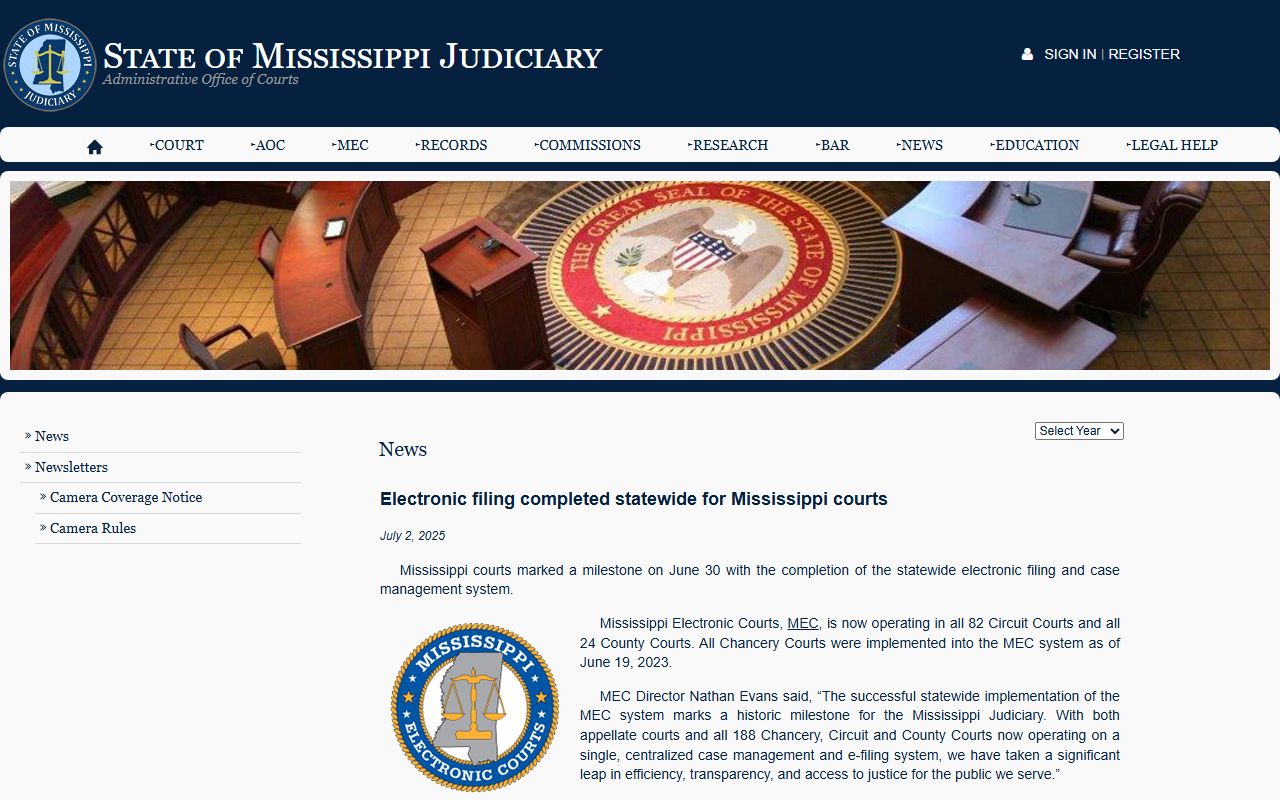
That same statewide rollout put all 82 counties on one system, so Quitman County felony dockets now move through Mississippi Electronic Courts like the rest of the state.
- Open the PAMEC registration site and create a public access account. Reported fees are $10 per year plus 20 cents per page.
- Sign in with PAMEC credentials, not an attorney filing login, if you only need to view a case.
- Search by defendant name or by case number, then narrow by court and date.
- Open the case to read the docket, the charges, and the disposition.
- If the case is restricted or predates the system, call the Circuit Clerk at 662-326-8003 or visit Suite 4 at 220 Chestnut Street in Marks.
The general structure of the system is explained on the Mississippi Electronic Courts page. Appellate dockets for cases on appeal can be searched at courts.ms.gov by party name, attorney name, or case number.
Stages of a Criminal Case
A Quitman County criminal case moves in steps, and each step leaves a mark in the record. Reading the docket in order tells the story of the case. The flow below is the path a felony usually takes from the filed charge to the final sentence.
Case flow: Charges Filed › Arraignment › Pretrial / Motions › Plea or Trial › Disposition › Sentencing
| Stage | What Happens |
|---|---|
| Charges Filed | An affidavit, information, or grand jury indictment opens the case. The charge, statute, and count number enter the file. |
| Arraignment | The court reads the charges. The defendant enters a plea. Bond and counsel are addressed. |
| Pretrial / Motions | Lawyers file motions, exchange discovery, and ask the judge to rule on evidence and procedure. |
| Plea or Trial | The defendant pleads, or a judge or jury decides guilt. Most cases end in a plea. |
| Disposition | The court records the outcome of each charge: guilty, not guilty, dismissed, or otherwise resolved. |
| Sentencing | After a conviction, the court sets the punishment and any probation, restitution, or fines. |
Note: A felony begins with a first appearance and bond in Justice Court, then moves to Circuit Court once a grand jury returns an indictment.
Prosecutors in Quitman County Criminal Cases
Two prosecuting offices appear in the county criminal record. The split depends on the level of the charge. The District Attorney handles felony prosecutions in Circuit Court and presents cases to the grand jury. The County Prosecuting Attorney handles county-level misdemeanor and Justice Court matters. The sheriff or police make the arrest. The prosecutor decides what charge, if any, gets filed in court.
District Attorney Brenda F. Mitchell
P.O. Box 848, Cleveland, MS 38732
662-843-8000
Felony prosecutions and grand jury matters for the Circuit Court district.
County Prosecuting Attorney Micheal Roy
P.O. Box 209, Marks, MS 38646
662-326-4223
County misdemeanors and Justice Court level prosecutions.
The Circuit Court for Quitman County sits in District 11, served by judges Linda F. Coleman, W. Hunter Nowell, and Charles E. Webster. The state describes the work of these courts on the Mississippi Circuit Court page. The county Justice Court handles the first appearances, bonds, and preliminary hearings that start many felony files before they reach the grand jury.
What a Quitman County Criminal Court Record Shows
A criminal case file is built from many fields. Some are basic, like the case number and the parties. Others track the legal heart of the case, like the charge, the plea, and the sentence. The table below lists the fields a Mississippi Electronic Courts criminal record commonly holds and what each one tells a reader.
| Field | What It Shows |
|---|---|
| Case Number | The court-assigned number used to find and track the file. |
| Court | Circuit, Justice, or municipal court, which sets where the file lives. |
| Defendant | The person charged, with the State of Mississippi as the other party. |
| Charges | The charge name, statute, count number, and classification. |
| Bond | The amount set for release, or a no-bond status. |
| Plea | The defendant's formal answer to each charge. |
| Disposition | The final outcome of each charge in the case. |
| Sentence | The punishment, plus any probation, restitution, or court costs. |
| Docket Entries | A dated list of every filing, hearing, and order. |
Personal identifiers are often hidden. Court rules require filers to keep Social Security numbers, dates of birth, minor-child names, financial account numbers, and home addresses out of public filings except where allowed. A public copy can carry redactions even when the case is open. The full set of court records beyond criminal files is described on the county court records page.
Charges vs. Convictions in Quitman County
Being charged is not the same as being found guilty. A charge is an accusation. A conviction is a finding or a plea of guilt. A criminal court record can show charges that were dropped, dismissed, reduced, or that ended in acquittal. Reading only the charge can give a false picture. The disposition line is what tells you how a case actually ended.
| Charge | Conviction | |
|---|---|---|
| Stage | Accusation when the case is filed | Verdict or guilty plea |
| Burden of Proof | Probable cause | Beyond a reasonable doubt |
| Outcome | May be dropped or dismissed | Leads to a sentence |
| Public Record | Yes | Yes |
This is why the same file can list a serious charge next to a dismissal. The charge shows what the prosecutor alleged. The conviction, if any, shows what the court found. Always check both before drawing a conclusion about a person.
Reading Dispositions and Sentences
The disposition is the most important line in a Quitman County criminal record. It states how each charge was resolved. The sentence follows a conviction and sets the punishment. A few common terms appear again and again, and knowing them makes the record far easier to read.
- Guilty plea
- The defendant admits the charge instead of going to trial.
- Nolo contendere
- A no-contest plea that accepts punishment without admitting guilt.
- Dismissed
- The charge is dropped by the court or the prosecutor.
- Acquitted
- A judge or jury finds the defendant not guilty.
- Probation
- A supervised sentence served outside of custody.
- Revocation
- A later step that alleges a violation of probation or release terms.
A sentence may combine several parts. It can list jail or prison time, probation, fines, court costs, and restitution to a victim. Some entries note time suspended or credit for time already served. When a sentence is hard to read, the Circuit Clerk can confirm what the order says.
Sealed vs. Expunged Records
Some Quitman County criminal records are removed from public view. There are two main ways this happens, and they are not the same. A sealed record still exists but is hidden from the general public. An expunged record is treated, by law, as if the case never occurred. Eligibility for either is narrow and charge-specific.
| Sealed | Expunged | |
|---|---|---|
| Visibility | Hidden from the public | Removed and treated as if it never existed |
| Law Enforcement | Limited access remains | Very limited access |
| Public Search | Will not show in PAMEC | Removed from public records |
| Eligibility | Set by court order and statute | Set by Miss. Code Section 99-19-71 |
Mississippi expunction runs through Miss. Code Section 99-19-71. The petition is filed in the court where the conviction or disposition occurred. Some misdemeanors qualify, and certain felonies can qualify after waiting periods and full completion of the sentence. Many violent, sex, trafficking, and public-corruption offenses are excluded. A granted order is sent to the agencies that hold public records of the case.
Important: An expunction order does not instantly update private databases, so a cleared Quitman County record may still appear on third-party sites for a time.
Public Access to Quitman County Criminal Records
Most criminal court files in Mississippi are public. The general rule comes from the state Public Records Act, which treats records as open unless a law makes them confidential. Court files add their own layer, since court rules, sealing orders, and the electronic system decide what can be viewed online versus at the counter. The Public Records Act is summarized on the Mississippi Ethics Commission page.
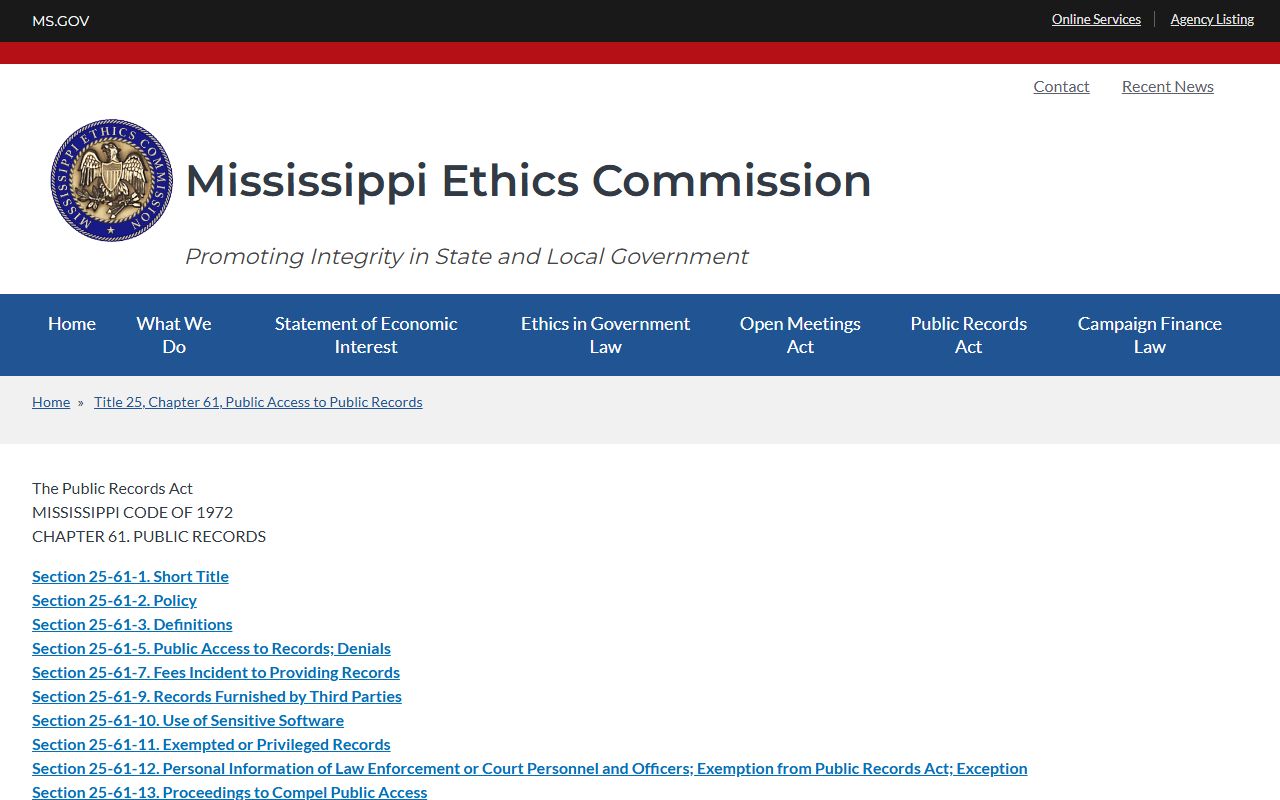
That overview frames the open-records principle that lets the public inspect most Quitman County criminal case files, subject to the court rules and confidentiality laws noted below.
Key Statutes:
Mississippi Code § 25-61-1 - sets the policy that public records are open for inspection unless a law makes them exempt.
Mississippi Code § 25-61-5 - a public body cannot push a response past seven working days after a request unless another rule applies.
Note: Online viewing through PAMEC is a paid, registered channel, while in-person access at the clerk counter remains the fallback for anyone who cannot find or open a case online.
Sheriff Records vs. Court Files
The arrest record and the court file are two different things. The sheriff or police create the arrest report and booking record when a person is taken into custody. The court file begins later, when a charge is filed. A docket alone will not always tell you about the arrest, and a booking record will not show how a case ended.
For arrest and booking details in Quitman County, the sheriff's office is the source. Sheriff Oliver Parker, Jr. can be reached at 662-326-3131. For who is currently held, the county inmate and custody options are covered on the inmate records page. To check a case after charges are filed, return to the court file through PAMEC or the Circuit Clerk.
- Arrest and booking report: contact the sheriff's office.
- Filed charge and case outcome: search the court file in Circuit or Justice Court.
- Current custody status: use the inmate and custody channels for the county.
Restricted Quitman County Criminal Records
Not every criminal matter is open. Youth Court records are generally confidential. Law-enforcement records involving children fall under Miss. Code Section 43-21-255, which limits who may see them. These files are usually available only to the child, a parent or guardian, counsel, the youth court, law enforcement, schools, or other authorized parties. They should never be treated as ordinary public records.
Sealed cases also stay out of public view. In the electronic system, a restricted file may return a permission notice, and some documents are limited to attorneys of record. Several sensitive categories are blocked from remote access even when the underlying case is not sealed. Ongoing investigations and certain filings can be withheld until the court allows release.
When a record is restricted, the right step is to ask the court that holds the case. The Circuit Clerk can explain whether a file is sealed, restricted, or simply not yet electronic. For appointed-counsel or public-defense questions on a specific case, the court handling that case is the office to contact.
Note: A permission error in the online system does not always mean a record is sealed, since some files are simply limited to the parties or their attorneys.